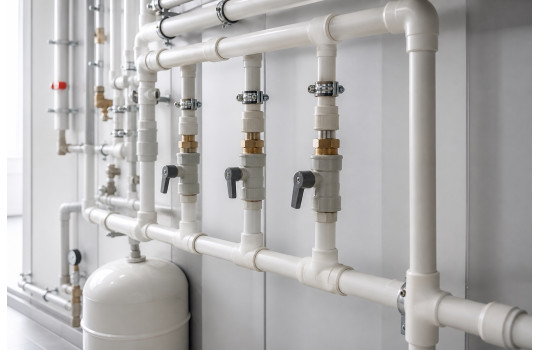
Plastic pipes are not selected only by diameter. A reliable pipe system is the result of matching the material, operating temperature, pressure, fittings, route design and installation technology to one engineering task.
PP-R pipe systems are commonly used for cold water, hot water distribution and heating circuits where the working parameters match the pipe series. They are light, corrosion-resistant and convenient for concealed or open installation.
Before choosing a pipe, check the intended application, maximum operating temperature, pressure, pipe diameter, wall thickness class, reinforcement type and compatibility with fittings. For heating systems, also check how the pipe behaves at elevated temperature over time.
Reinforcement is used to reduce linear expansion and improve dimensional stability. Fiberglass or aluminium-reinforced pipes can be useful for hot water and heating, but they should be selected by the route, temperature and installation method rather than by the word “reinforced” alone.
The outer diameter is not the same as hydraulic capacity. Inner diameter, flow rate, pump performance and pressure loss influence comfort, noise and system balance. When replacing older metal pipes, do not copy sizes blindly: the system should be checked hydraulically.
Plastic expands when heated. Long straight runs need fixed points, sliding supports, compensation loops or routing that allows controlled movement. If expansion is ignored, the pipe may bend, push fittings or create stress in hidden sections.
A clean perpendicular cut, correct heating time, proper insertion depth and cooling without rotation are essential. Overheating narrows the inner diameter; underheating weakens the joint. After installation, the system should be pressure-tested before closing walls or floors.
Common mistakes include mixing non-compatible fittings, welding dirty or wet pipe ends, using too few supports, hiding untested joints, ignoring expansion and choosing pipe only by price. These details often define the real service life of the system.
| Parameter | Why it matters | What to confirm |
|---|---|---|
| Application | Cold water, hot water and heating place different loads on the pipe. | Use the pipe series only within its declared purpose. |
| Temperature and pressure | Long-term temperature has more influence than short peak loads. | Compare operating conditions with the technical datasheet. |
| Reinforcement | It changes expansion behaviour and installation requirements. | Check whether fiberglass or aluminium reinforcement is suitable for the route. |
| Fittings | A system is only as reliable as its weakest connection. | Use compatible fittings and follow the same system standard. |
| Installation quality | Welding, support spacing and pressure testing define service life. | Confirm clean cuts, correct heating time and pressure testing before closing walls. |


